



Summary:
Microsoft 365 Copilot Business has removed cost and complexity barriers, bringing powerful AI capabilities to SMBs and accelerating demand for MSP-led support. But successful adoption depends on more than licences. Tenants need structured readiness across governance, security, and user enablement. MSPs that build these capabilities can differentiate, increase recurring revenue, and reduce churn. Those that don’t risk falling behind as clients expect guided, compliant Copilot deployment and ongoing management at scale.
|
Time to Read |
|
|
What You’ll Learn |
|
|
Next Steps |
|
|
Benefits for SMBs |
|
Scope and Limitation Statement
This covers Microsoft 365 Copilot Business's pricing, feature set, and the governance risks MSPs should assess before rollout. It doesn't cover the enterprise Copilot SKU's pricing or eligibility differences beyond what's noted or cover Copilot Studio agent-building specifics.
Versioned Specifics
- General availability: December 1, 2026
- Announced: Microsoft Ignite 2025
- Price: $21 per user/month (annual commitment)
- Max users: 300, no minimum seat requirement
- No separate enterprise M365 plan required
- Included: Copilot in Word, Excel, PowerPoint, Outlook, Teams; Copilot Chat, Pages, Notebooks, Copilot Studio agent creation
- Wave 3 features referenced: Copilot Cowork, model choice (including Claude), in-document collaboration
Why Copilot Business Means MSPs Need to Start Offering Copilot Readiness Services
Microsoft's launch of Microsoft 365 Copilot Business in December 2025 wasn't just a pricing announcement. It was a signal that MSPs cannot afford to miss.
By bringing AI-powered Copilot capabilities to SMBs at $21 per user per month with no minimum seat requirement, Microsoft dramatically lowered the barrier to enterprise-grade AI. The organisations your tenants have been benchmarking against for years are already using Copilot. Now that it’s within reach for them as well, they’ll expect your MSP to provide support.
That's a significant commercial opportunity for MSPs, but only the ones that are prepared to take advantage of it. You need to prove that you can help customers adopt Copilot safely and consistently before you can sell managed Copilot services at scale.
But first, let’s review the launch of Copilot Business and take note of its impact.
Copilot Business: What's Changed Since Launch
When Microsoft announced Copilot Business at Ignite 2025 and made it generally available on December 1st of 2026, it represented a meaningful structural shift in how AI would reach the SMB market.
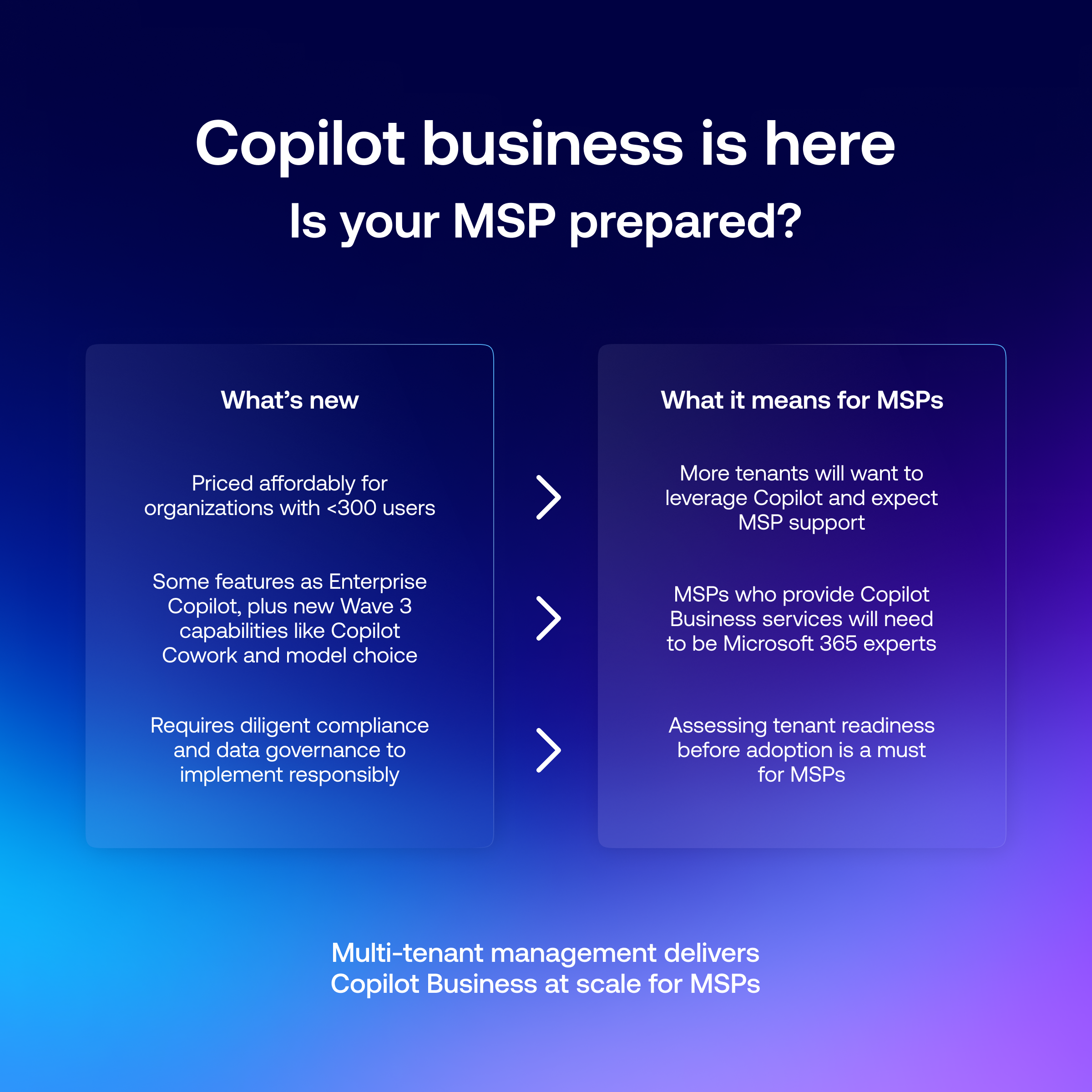
The product delivers the same feature set as the enterprise Copilot SKU, including:
- Copilot in Word, Excel, PowerPoint, Outlook, and Teams
- Copilot Chat, Pages, Notebooks, and agent creation via Copilot Studio
But here’s the kicker: Copilot Business is priced specifically for organisations with fewer than 300 users and no requirement for enterprise licensing prerequisites. Bundled pricing options combining Copilot Business with Microsoft 365 Business Standard or Premium have also simplified the purchase process considerably.
Post-Launch Reception
Reception has been broadly positive in the channel. PCMag gave Copilot Business a 4.0/5 rating in their long-form review, specifically praising its breadth of available features and integration with Microsoft products.
Copilot’s previous success with enterprise level organizations makes the proposition of a more affordable version aimed at SMBs undeniably attractive. Microsoft's own data shows that since 2023, over 70% of Fortune 500 companies have used Copilot in some form, with the platform growing across industries at pace.
For MSPs, the writing is on the wall. Copilot is no longer an enterprise curiosity; it's headed for mainstream adoption.
Continued Evolution
Notably, Copilot also continues to evolve rapidly. Wave 3 of Microsoft 365 Copilot (announced in early 2026) added capabilities such as:
- Copilot Cowork for handling multi-step, longer-form tasks
- Deeper in-document AI collaboration across the Office suite
- Model choices such as Claude within the Copilot interface
These aren't incremental updates. They meaningfully expand what SMBs can expect Copilot to do for them, and what they'll need their MSPs to help them manage.
Key facts at a glance:
- $21/user/month is the list price for Copilot Business (annual commitment)
- Up to 300 users with no minimum seat requirement
- Same features as Enterprise Copilot including agents, Work IQ, and Copilot Chat
- No separate enterprise M365 plan required, allowing SMBs to add it to existing Business plans
- Wave 3 capabilities include Copilot Cowork, model choice, and in-document collaboration
More Tenants Wanting Copilot Is an Opportunity for MSPs
For MSPs, the commercial logic is straightforward: cheaper licences and better functionality mean more customers are going to ask you about Copilot sooner.
With price no longer a major barrier, the most important consideration for your tenants becomes their readiness. This is where you need to be positioned to add value.
Selling the licence isn’t enough. You’ll need to confidently guide tenants through what comes before and after: from configuration and user enablement to ongoing policy management. You need to become their trusted AI advisor.
What MSPs Stand to Gain
MSPs who have established structured Copilot readiness and deployment practices are already seeing meaningful results from this positioning:
- A differentiated value proposition that moves the conversation beyond licence cost and towards adding long-term value
- Stickier relationships built around ongoing governance management rather than one-time deployments
- Higher per-seat revenue through Copilot consulting, readiness assessments, and post-deployment managed services
- Reduced churn risk as tenants associate AI productivity outcomes with their MSP relationship
The Risks Are Real, and They're Not Overblown
Copilot governance concerns are the primary obstacle you’ll face in successfully setting your tenants up to embrace its capabilities. Here’s why:
Microsoft Copilot uses Microsoft Graph to ground responses in a user’s Microsoft 365 data and permissions. Depending on the scenario, data may be retrieved from Microsoft Graph directly or accessed in real time from connected external systems.
In well-managed environments, that's fine. But many SMBs have years of accumulated permission sprawl, unmanaged SharePoint sites, anonymous sharing links, and inconsistent sensitivity labelling. Without MSP support that can reliably remediate these issues, Copilot runs the risk of quickly making oversharing problems visible and creating exploitable vulnerabilities.
Additional Post-Launch Challenges
The December launch went smoothly from a technical standpoint. What surprised many MSPs was the scale of the non-technical friction.
Permission sprawl was worse than expected
Tenants who assumed their Microsoft 365 environments were reasonably tidy discovered quickly that years of organic growth had created extensive oversharing. The work to remediate this before Copilot deployment was often significantly larger than anticipated.
User expectations weren’t always realistic
Copilot Business is genuinely capable, but it's also prompt-dependent. Users who expected an autonomous AI assistant and received a responsive-but-passive tool sometimes experienced frustrations. Those with MSP partners who set clearer expectations through structured onboarding fared better.
SMB compliance exposure went underestimated
Regulated industries such as legal and financial services often hadn't mapped Copilot into their compliance obligations before deployment. Auditors are now beginning to ask specifically about AI governance, and tenants without documented frameworks are in a difficult position.
Addressing Risks at Scale via Multi-Tenant Management
None of the above is a reason for customers to avoid Copilot. Instead, it is a reason for MSPs to lead the conversation on governance before deployment and to position Copilot readiness as an absolute requirement.
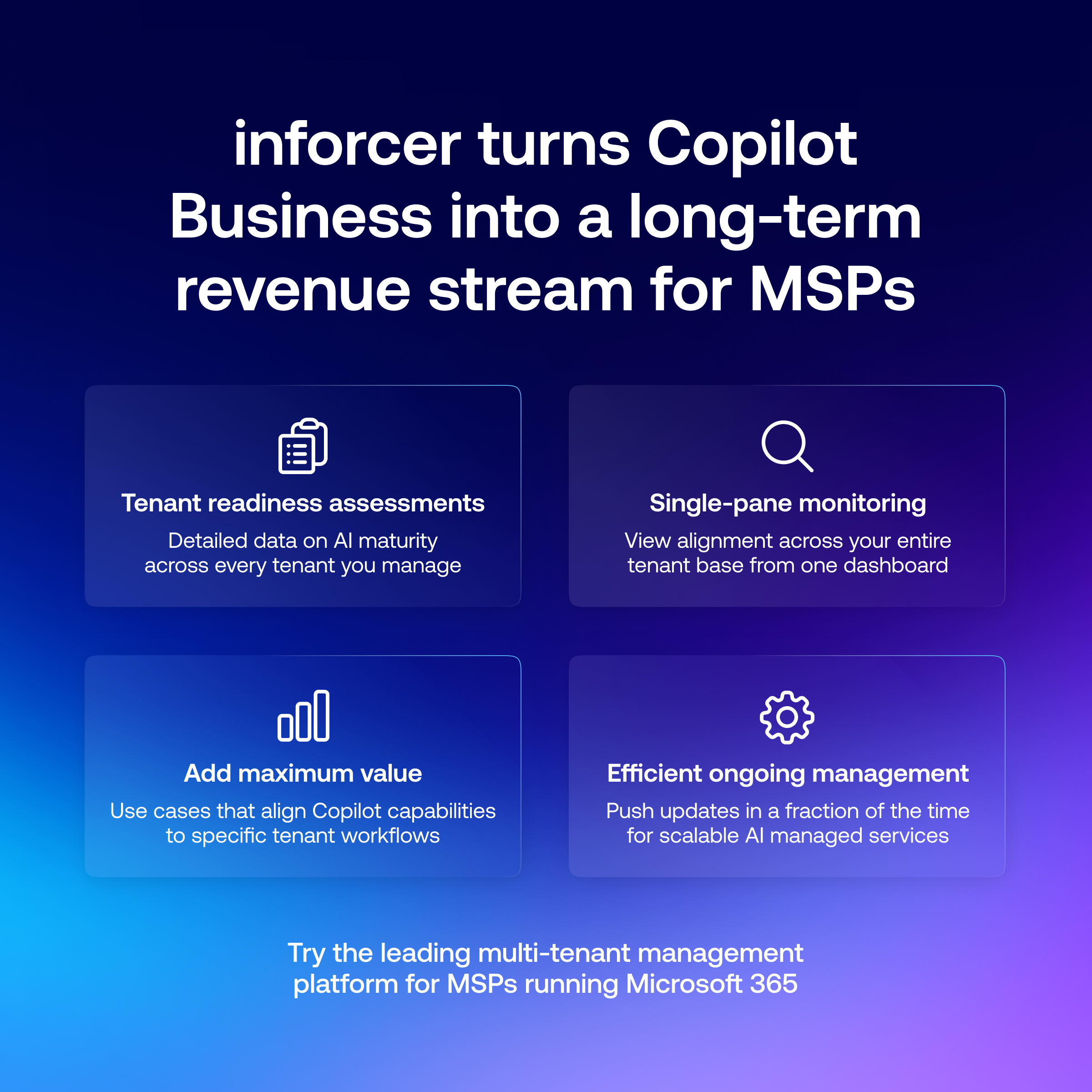
Multi-tenant management platforms such as inforcer enable MSPs to provide policy management and compliance controls across multiple Microsoft 365 tenants from a single dashboard. This makes it easier to efficiently enforce the settings, defaults, and governance postures that Copilot deployments require, since it eliminates the time-consuming manual labour of managing each tenant individually.
Assessing Copilot Readiness for Your Tenants
A structured assessment should be the foundation of any MSP's managed Copilot services. This needs to cover more than a permissions report and provide deep data on the Microsoft products that impact how Copilot performs. The following areas are critical:
|
Readiness Pillar |
What to Assess |
Key Tools |
|
Data Governance |
Oversharing, anonymous links, site ownership |
SharePoint Advanced Management, Purview DAG Reports |
|
Sensitivity Labels |
Label coverage across Microsoft 365 content |
Microsoft Purview Information Protection |
|
Identity & Access |
MFA, Conditional Access, least-privilege |
Microsoft Entra ID, Privileged Identity Management |
|
External Access |
Guest accounts, stale permissions |
Entra ID, SharePoint Admin Centre |
|
Compliance |
Regulatory mapping, AI governance documentation |
Microsoft Purview Compliance Manager |
|
User Readiness |
Champion identification, role-based training |
Viva Insights Copilot Dashboard, structured onboarding |
Using inforcer to Surface the Specific Value of Copilot Business for Tenants
The number of billable hours required to manually cover all of the bases listed above cannot be overstated, especially for MSPs with dozens or even hundreds of tenants. In fact, this often represents such an investiture of time and effort that it simply becomes infeasible at scale.
Multi-tenant management is the only realistic solution to this problem. Using the inforcer platform provides MSPs with a single-pane solution for viewing every tenant’s alignment with your preferred Microsoft 365 security and compliance baselines, but it also includes the ability to perform dedicated Copilot Readiness Assessments that show tenants precisely how to effectively integrate Copilot into their existing workflows.
This allows MSPs that use inforcer to offer more than simple configuration checks. It unlocks a way to show tenants exactly where Copilot Business can deliver meaningful impact for their organizations and encourage them to entrust you with the responsibility of providing the managed services they need.
Related: Delivering Copilot without the Risk: inforcer New Releases
The Window Is Now
Copilot Business has opened the door for SMB AI adoption at a meaningful scale. That means your MSP’s tenants will expect to arrive at deployment with a governed, secure environment and a workforce that understands how to use it.
MSPs that build structured Copilot readiness services now will be significantly better positioned than those who treat Copilot as a licence to sell and then move on. That means assessment, remediation, deployment, and ongoing governance.
This is where platforms like inforcer become force-multipliers: running detailed readiness assessments, enforcing policy consistency at scale, monitoring for configuration drift, and ensuring that when customers expand their Copilot usage, their governance posture keeps pace.
The AI opportunity for SMBs is real. The readiness gap is equally real. MSPs who bridge that gap will be the ones that customers call first, for Copilot and everything that follows.
Learn how inforcer helps MSPs manage Copilot governance across multiple Microsoft 365 tenants:
Frequently Asked Questions
What is Microsoft 365 Copilot Business and when is it available?
It's a version of Copilot for businesses with up to 300 users, priced at $21 per user/month with no minimum seat requirement and no separate enterprise M365 plan needed. It was first announced at Ignite 2025, with an availability date of December 1, 2026.
What features does Copilot Business include?
The same feature set as the enterprise Copilot SKU: Copilot in Word, Excel, PowerPoint, Outlook, and Teams, plus Copilot Chat, Pages, Notebooks, and agent creation via Copilot Studio, along with Wave 3 capabilities like Copilot Cowork and model choice, including Claude.
What governance risks should MSPs check for before enabling Copilot?
Permission sprawl in existing Microsoft 365 environments, unmanaged SharePoint sites and anonymous sharing links, inconsistent sensitivity labeling, and compliance exposure in regulated industries — since Copilot surfaces data based on whatever permissions a user's account already has via Microsoft Graph.
What are the readiness assessment pillars MSPs should check?
Data governance, sensitivity labels, identity and access, external access, compliance, and user readiness. MSPs can save hours of billable engineering time per customer by using 365 Manager by inforcer to assess these areas for every tenant they manage from a single dashboard.
Why is Copilot Business a business opportunity for MSPs, not just Microsoft?
Removing the licensing barrier (lower price, no seat minimum) means more tenants will want Copilot, but most aren't governance-ready — creating demand for MSP-led readiness assessments, configuration, and ongoing management that go beyond simply reselling the license.
Share this

How to Assess Microsoft Copilot Readiness as an MSP

Delivering Copilot without the risk: inforcer new releases